Nowadays, many young people love to ride mountain bikes outdoors. For some mountain bike beginners, how to set the tire pressure of mountain bikes is a difficult problem. Once the tire blows out, in addition to hurting personal safety, it will also cause an impact to the rim. If you can set the tire pressure suitable for you in advance, you can cross the ditch and cross the ridge like riding on the ground! Let’s take a look at the factors that affect the tire pressure of mountain bikes and how much is suitable for mountain bike tires.
Before getting your proper tire pressure, we need to know what factors affect mountain bike tire pressure.
1.The weight of the rider:
This is obvious, the heavier the weight, the higher the tire pressure required.
2.Tire capacity:
If the tire volume is larger, the most suitable tire pressure is lower.
3.Terrain:
For example, very bumpy dirt roads require lower air pressure to obtain greater cushioning to ensure pedaling efficiency. Rocky terrain requires more air pressure to prevent tire blowouts or frequent bead bumps.
4.The rider’s fitness and skill level:
Faster and more aggressive riders need higher tire pressures. Because they are more powerful when bending and rolling over obstacles. More skilful riders can have lower air pressure because they can deftly avoid obstacles.
5.Tire structure:
Thinner and lighter tires require higher tire pressure than thicker tires.
6.Is it a tubeless tire?
Tubeless tires greatly reduce the chance of a tire blowing up, so lower air pressures are suitable for use.
7.Rim structure:
The minimum air pressure of the UST vacuum system can be lower than that of the tubeless tires modified by ordinary rims. The hookless design of the ENVE rim also makes it less prone to leaks at low air pressure.
What is the proper pressure for mountain bike tires?
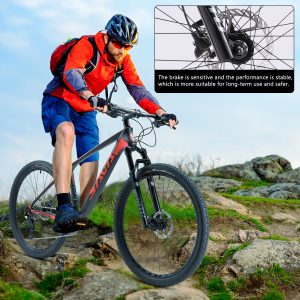
Generally, the tire pressure of mountain bikes is between 30-65psi. The tire pressure setting should be adjusted taking into account many factors such as tire volume, rider weight, fabric density, road surface conditions, etc. In general, the recommended tire pressure for mountain bikes is 10% of the rider’s weight. This rule generally applies to very light or very heavy riders. In addition, the upper limit of tire pressure is marked on the outside of the tire, and do not exceed the upper limit.
For example, a rider weighing 60kg using 26×2.0 mountain bike tires may find that 40psi tire pressure is too hard and lacks grip. On the contrary, if an 85kg rider rides it, the tire pressure will be too low. Too low pressure on a mountain bike will increase rolling resistance, but too high pressure can easily cause the tire to bounce. It takes long-term experience to find a moderate tire pressure. The heavier the weight, the higher the tire pressure, and the pressure of the front wheel is lower than that of the rear wheel.
Appropriate tire pressure can not only obtain better grip, will not be excessively deformed when turning, but also play a suitable buffer when passing through rough terrain, and will not be prone to a tire blowout or side leakage.